
























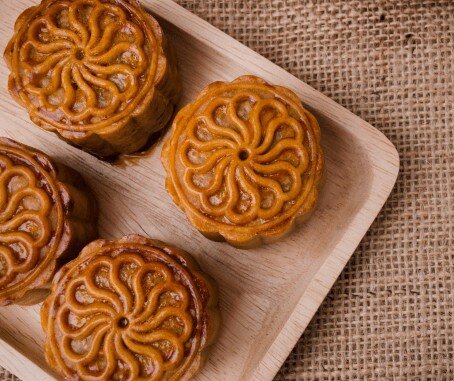
Mooncakes are an essential part of the Chinese Mid-Autumn Festival, celebrated to honor the harvest and the moon. These sweet treats symbolize unity and happiness and are traditionally shared during family gatherings. Want to try making this iconic dessert at home? Here’s a simple recipe for classic mooncakes that you can easily prepare!
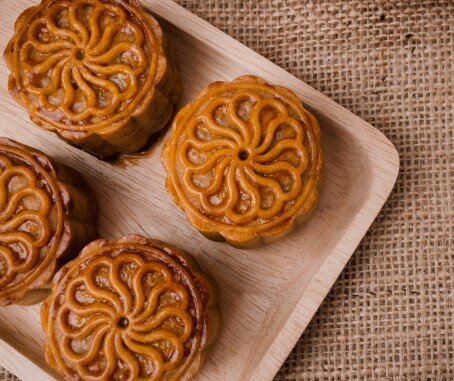
Traditional mooncakes: a recipe for Chinese mooncakes
Thin golden dough, sweet lotus seed or red bean paste, and optional salty duck yolk in the middle. Make classic Cantonese-style baked mooncakes at home.
What are mooncakes?
Mooncakes, or yuèbǐng (月饼) in Chinese, are among the most famous foods associated with the Chinese Mid-Autumn Festival. It falls on the 15th day of the eighth month of the traditional lunar calendar and is associated with family gatherings, moon-gazing, and the sharing of mooncakes.
There are many regional varieties. This recipe makes baked mooncakes in the Cantonese style - with a thin golden crust and a dense sweet filling. Traditional fillings include lotus seed paste or red bean paste, and often a salty duck yolk, which resembles a full moon in the center of the cake.
Raw materials
The recipe is set for approximately 50 gram mold. For a different mold size, keep approximately the same ratio of dough to filling.
For the dough
- 85 g plain flour
- 52 g golden or invert syrup
- 24 g neutral vegetable oil
- approximately 2 g of food-grade alkaline water (kansui / lye water)
For filling
- approximately 240 g sweet lotus seed or red bean paste
- 4 salted duck yolks, optional
To finish
- 1 egg yolk
- 1 teaspoon water
- a small amount of plain flour for dusting the mold
How to make traditional baked mooncakes
Prepare the dough
Mix the golden syrup, oil and food-grade alkaline water thoroughly. Add the sifted flour and use a wooden spoon or spatula to combine into a soft, even dough. Do not overmix.
Cover the dough and let it rest for about 60 minutes . While it rests, it will become more pliable and easier to wrap around the filling.
Divide the filling
For one 50-gram mooncake, use approximately 30 g of filling . Shape the paste into eight firm balls.
If using salted duck yolks, divide them in half. Coat each half with the paste so that the paste, including the yolk, weighs approximately 30 g. For the yolks, also follow the manufacturer's instructions for cooking them.
Wrap the filling in the dough
Divide the dough into eight pieces, each weighing approximately 20 g . Shape each piece into a ball and carefully flatten it between your palms or with a rolling pin into a thin circle.
Place the filling in the center. Gradually pull the dough upwards until the filling is completely enclosed. Press the seam firmly and gently round the mooncake between your palms.
Print a traditional pattern
Lightly dust the mooncake mold with flour and tap out the excess. Place the filled ball into the mold and press it firmly onto a baking sheet lined with baking paper. Lift the mold vertically upwards.
Use only a minimum of flour – too thick a layer may remain visible after baking and reduce the sharpness of the pattern.
Bake the pattern first
Preheat the oven to 190°C, top and bottom heat . You can spray the mooncakes very lightly with water from a distance. Bake for about 5 minutes to firm up the surface and the printed pattern.
Brush with egg and bake.
Remove the mooncakes and let them cool slightly for about 5 to 10 minutes. Mix the yolk with a teaspoon of water.
Brush the surface with a very thin layer of egg. There must not be much liquid left, especially in the delicate relief, otherwise the pattern will be watered down. Reduce the temperature to approximately 175–180 °C and bake for a further 8 to 12 minutes, until the mooncakes are evenly golden brown.
Let the mooncakes sit
After baking, the dough may be firmer and duller on the surface. Let the mooncakes cool completely and then store them in a sealed container.
After about 24 to 48 hours, the dough will gradually soften, darken, and become more pliable. This is when classic baked mooncakes are at their best. Always adjust the storage method to the filling and yolks used.
Details that decide the outcome
Mooncakes are not technically difficult, but with thin dough, precise weighing and the correct ratio of dough to filling are important. Therefore, we recommend weighing individual portions the first time you bake them.
Three common mistakes when making mooncakes
Dough too thick
For Cantonese mooncakes, the dough should be a thin wrapper around the filling. A very thick layer will produce a drier and less typical result.
A lot of flour in the form
The mold only needs a light dusting. Excess flour will leave a pale surface and may obscure the detail of the ornament.
Too many eggs
The glaze can build up in the recesses and the pattern will be less pronounced after firing. A thin layer is better than a heavily painted surface.
What to know before your first baking
Can I use honey instead of golden syrup?
We do not recommend it as a direct substitute. Honey has a different composition and taste and can change the color and consistency of the dough. For a classic result, use golden or suitable inverted syrup.
Do I have to use salted duck yolk?
No. You can only fill mooncakes with lotus seed paste or red bean paste. The salted egg yolk creates the traditional sweet-savory combination, but it is not mandatory.
What is alkaline water used for?
A small amount of food-grade alkaline water affects the color, structure, and properties of traditional dough.
Why are mooncakes harder after baking?
This is common with this type of mooncake. After resting, the fat and moisture are more evenly distributed between the filling and the dough, and the surface gradually softens.
Can I use a different mold size?
Yes. Weigh the capacity of the pan and adjust it to the total weight of one cookie. For Cantonese style, keep the filling as the bulk of the total weight and the dough as just a thin wrapper.
Mooncakes taste best when they are given time
So don't rush them straight to the table after baking. After a day or two of resting, they will acquire their typical softer skin, a richer golden brown color, and a more balanced flavor. Cut them into smaller pieces and serve, for example, with unsweetened tea.



Add new comment:
Add reply to comment: